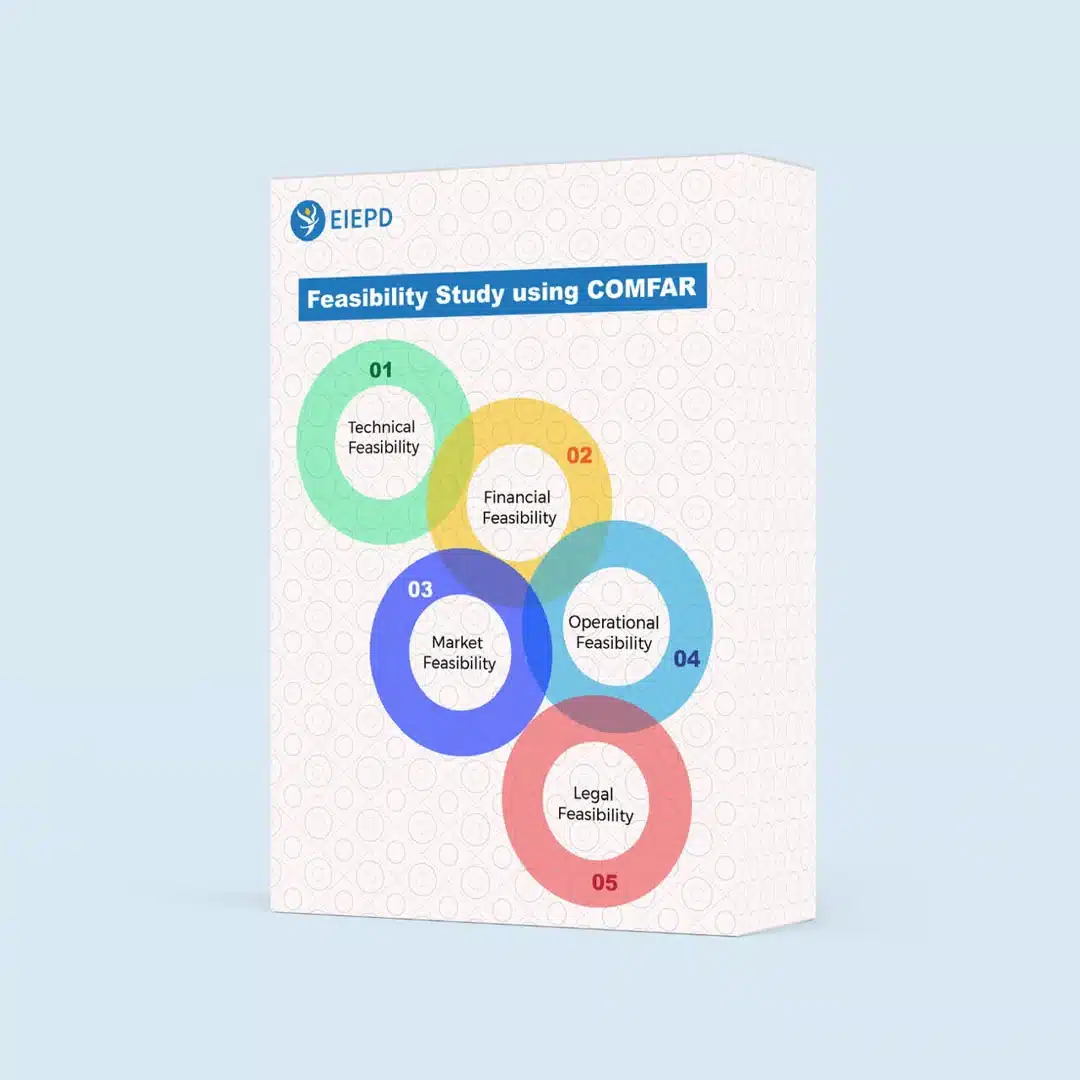
Part 1 – Economic Terms and Financial Fundamentals
Learn the essential economic and financial terminology used in feasibility studies, including:
- Capital Expenditure (CAPEX)
- Operating Expenditure (OPEX)
- Cash Flow
- Net Present Value (NPV)
- Internal Rate of Return (IRR)
- Payback Period
- Discount Rate
- Inflation and Escalation
- Depreciation
- Taxes and Financing Concepts
This section establishes the financial foundation required for evaluating industrial projects.
Part 2 – Cost Estimation
Develop a systematic approach to estimating project costs during different stages of project development. Topics include:
- Cost estimation methodologies
- Equipment cost estimation
- Installation and indirect costs
- Lang factors and factorial methods
- Accuracy classes of estimates
- Contingency and escalation
- Total Capital Investment (TCI)
- Operating cost estimation
Economic assumptions and cost breakdown
Part 3 – Practical COMFAR Expert Examples
Apply the concepts learned by building and evaluating real industrial projects using COMFAR Expert. This section includes two complete case studies demonstrating:
- Project data preparation
- Investment cost input
- Operating cost development
- Revenue forecasting
- Financing scenarios
- Financial statements
- Economic indicators (NPV, IRR, Payback Period, etc.)
- Sensitivity analysis and project evaluation
These hands-on examples enable participants to confidently perform feasibility studies for industrial projects.
Part 4 – Final Project and Complete Feasibility Study
Integrate all the knowledge gained throughout the course to prepare a complete feasibility study for an industrial project. Participants will learn how to combine technical, financial, and economic analyses into a professional report suitable for investors, project developers, and decision-makers.